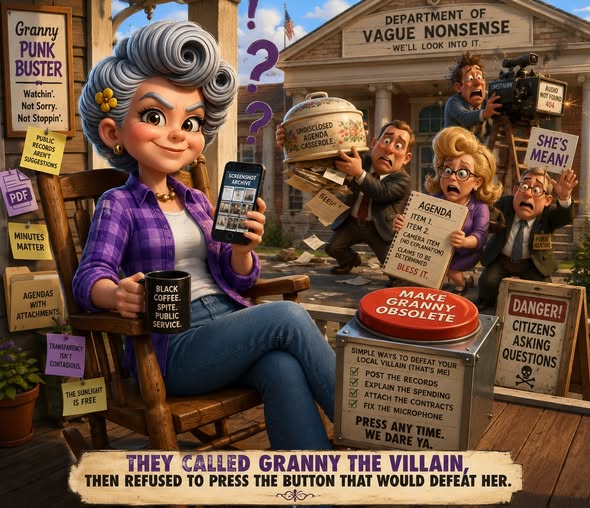
Gather round, porch lovers, because today we must speak of the great villain known as Granny Punkbuster. Hide your invoices. Lock up your vague agendas. Cover the livestream button with both hands. Somewhere, in a town hall with carpet older than some ordinances, a clerk just felt a chill run down their stapler.
They say Granny is the bad guy. The troublemaker. The thorn in the soft municipal backside. The old porch goblin rattling her cane at power, paperwork, and public nonsense. They whisper it in offices where public records go to be “looked into.” They grumble it behind polished desks where accountability is treated like a contagious rash. They say she is mean, divisive, negative, dramatic, obsessed, and possibly powered by black coffee, spite, and suspiciously accurate screenshots.
But here is the part that makes the whole accusation wobble around like a folding chair at a county fair: everything Granny does is advocating for her own extinction.
Not from lawsuits, bless their poorly skilled hearts. If a lawsuit was going to take Granny down, it would first need facts, standing, damages, and somebody with better aim than “she made me look goofy by repeating what I actually did.” That is not extinction. That is just a taxpayer-funded tantrum wearing dress shoes.
No, Granny’s real extinction does not come from courtrooms. It comes from competence.
Granny dies when the agendas start saying what they actually mean.
Granny fades when meeting packets are posted before the meeting instead of hidden like state secrets under a casserole lid.
Granny disappears when minutes are uploaded without citizens having to perform a scavenger hunt through city hall, paperwork, observation, and somebody’s government-flavored attitude.
Granny vanishes when livestreams have working audio, records are easy to find, public business is explained in public, claims are itemized, contracts are attached, votes are clear, and officials stop acting shocked that the public wants to know what the public’s own government is doing with the public’s own money.
That is the wild comedy of it all. The alleged villain keeps handing them the weapon that would defeat her.
Fix your broken nonsense, and Granny loses half her material by breakfast.
Post the records, and the porch gets quieter.
Explain the spending, and the speculation dries up.
Stop hiding behind foggy language, and the foghorn stops blowing.
Run clean meetings, keep clean records, answer fair questions, and suddenly the mighty menace of Granny Punkbuster shrinks down to an old lady posting recipes, weather complaints, and occasional warnings about people who put raisins where chocolate chips belong.
Across the world, this same tale plays out in different costumes. In one town, it is a mayor who thinks transparency means smiling near a ribbon-cutting. In another, it is a council that believes “claims to be determined” counts as public information. In another, it is a school board hiding behind policy language so thick it could be poured into potholes. In another, it is a department head who treats every question like an attempted burglary.
From Indiana to Istanbul, from small-town America to marble halls overseas, governments have always had one ancient enemy: somebody asking, “Where is the receipt?”
Not a sword. Not a cannon. Not a revolution. Just the receipt.
That is what terrifies the fragile kingdoms of nonsense. Not violence. Not chaos. Not mobs with pitchforks. Just ordinary people reading documents, comparing dates, saving screenshots, asking why the numbers do not match, and refusing to clap just because someone official entered the room.
Granny is not powerful because she is mean. She is powerful because broken systems depend on people getting tired. They depend on citizens being too busy, too confused, too intimidated, or too polite to keep asking. Granny’s great sin is that she does not get bored on command. She notices the missing minutes. She notices the vague agenda. She notices the camera item with no explanation. She notices the “hefty price tag” with no itemized public road map. She notices when the story changes shape like a wet paper hat in the rain.
And then she does the one thing local power hates more than criticism.
She remembers.
That is why they call her the bad guy. Not because she is actually wrong, but because she interrupts the sweet little lullaby of “just trust us.” She kicks the rocking chair right through the nap room. She turns on the porch light and suddenly all the roaches with titles start pretending they were just passing through.
But here is the truth, carved in granite, stapled to the agenda, and highlighted in Granny’s emergency shade of red: if Granny is the villain, then the cure is simple.
Be better.
That is it. No exorcism needed. No lawsuit. No public relations fog machine. No whispered campaign about how mean the porch lady is. Just do the job in a way that does not require citizens to become amateur auditors, record clerks, budget detectives, livestream technicians, legal translators, and unpaid historians just to understand what happened last Tuesday.
Imagine the horror.
A city posts complete agendas with attachments.
A county explains contracts before voting.
A board uploads minutes on time.
A department answers questions without acting like the citizen asked for nuclear codes.
A meeting livestream works from start to finish.
Claims show who got paid, how much, and why.
Public officials stop confusing criticism with persecution.
Somewhere, Granny’s rocking chair creaks softer. Her coffee cools. Her archive folder gathers dust. The porch light dims. The empire of screenshots begins to crumble. The old watchdog looks out at a functioning government and says, “Well hell, what am I supposed to complain about now?”
That is the ending they could write anytime they want.
They could make Granny obsolete.
They could bury her under professionalism.
They could drown her in transparency.
They could smother her with competence.
They could defeat her with a working microphone and a PDF upload.
But instead, too many of them keep choosing the dumbest possible path. They hide, dodge, mumble, delay, omit, forget, spin, and then act personally wounded when the porch starts laughing. They build Granny’s throne out of their own bad habits, then complain that she is sitting on it.
That is not villainy. That is supply and demand.
If the town keeps producing nonsense, Granny will keep bottling it, labeling it, and passing it around the porch like homemade jam with a warning label.
So how can Granny be the bad guy when her whole crusade is a suicide mission against her own relevance? How can she be the monster when every demand she makes is just another way of saying, “Please become competent enough that I am no longer necessary”?
The truth is, Granny is not trying to rule the town.
She is trying to retire.
She is trying to hang up the broomstick, close the screenshot vault, and spend her remaining porch years judging tomato plants and suspicious haircuts in peace.
But until the broken nonsense gets fixed, until public business is treated like public business, until records stop playing hide-and-seek in government basements, until “trust us” is replaced with “here is the document,” Granny remains.
Not because she wants to be the villain.
Because somebody has to keep asking why the heroes keep acting so damn guilty.