
Once upon a time, in a small but noisy kingdom where the truth was rarely hidden and almost never more than a few clicks away, there lived a strangely devoted little crowd who had developed a remarkable talent for being fooled in broad daylight. Not fooled by some brilliant mastermind, mind you. Not deceived by forged documents, secret tunnels, coded messages, or a villain with a cape and a volcano lair. No. These people could have the paperwork sitting directly in front of them, the screenshots stacked neatly beside it, the video paused at the exact moment the nonsense occurred, and a blinking link leading straight to the original source.
Still, they would stare at the evidence with the vacant wonder of a cow discovering a ceiling fan. Then someone with a title, a badge, a podium, a city seal, a government Facebook page, or a suspiciously confident tone of voice would stroll into the room and say, “You did not see what you just saw.” And the crowd would breathe a collective sigh of relief. Thank goodness. For one terrifying moment, they had almost been forced to think.
The kingdom’s officials soon discovered that they did not need to craft believable explanations. They did not need to answer questions directly. They did not need to produce records, timelines, receipts, or even a story that survived contact with basic logic. They merely needed to speak slowly, look mildly offended, and suggest that the person asking questions was being unreasonable. That was enough. The loyal villagers would immediately begin hauling buckets of water to extinguish a fire that was not imaginary, while loudly scolding the person who had pointed out the smoke.
Granny watched this ritual unfold again and again from her porch. A public record would appear. A contradiction would be exposed. A statement would collapse under the weight of its own nonsense. The proof would be right there, glowing like a neon sign in the middle of town square. Yet instead of taking a few minutes to read it, the villagers would turn toward the nearest official explanation and accept it with the solemn gratitude of someone receiving a prestigious civic honor.
They did not merely fall for gaslighting. They accepted it like an award. Some seemed almost proud of it. They carried it home, dusted it carefully, placed it on the mantel, and admired the shiny little plaque:
CERTIFIED DEFENDER OF THINGS I DID NOT BOTHER TO READ
Underneath, in smaller letters:
Presented for outstanding service in rejecting documented reality whenever reality becomes socially inconvenient.
Granny tried to help. She really did. She would post the documents, quote the minutes, point to the court records, circle the relevant section, explain where to click, and practically staple the truth to the barn door with a blinking arrow and a marching band. Still, the same people would arrive in the comments demanding proof. Not because proof had not been provided. Because proof had been provided, and reading it carried the dangerous possibility of learning something they did not want to know.
That was the real problem. The truth was not difficult to find. It was difficult to accept. There is a difference.
Some people do not want information. They want reassurance. They want someone in authority to tell them that their preferred version of reality is still intact, that the people they defended are still the good guys, that the questions are unfair, that the records are somehow mean, that screenshots are suspicious, that videos need “context,” and that audits are just paperwork written by overly serious adults with calculators.
They will reject ten pages of documentation because one official posted three sentences on Facebook. They will dismiss video evidence because someone used a calm voice while denying it. They will stare directly at a contradiction and insist the real problem is the person who noticed. It is almost impressive. Not intellectually impressive. More like watching someone walk into the same glass door twelve times and then accuse the door of harassment.
The kingdom’s gaslighters understood this weakness perfectly. They knew their most loyal defenders would do the hard work for them. The official did not need to explain the missing records. The villagers would invent explanations on his behalf. The official did not need to answer the question. The villagers would attack the person asking it. The official did not need to correct the contradiction. The villagers would declare that contradictions were suddenly irrelevant. The official did not need to prove anything. The crowd had already decided that requiring proof was rude.
That is how gaslighting thrives. Not because the lie is brilliant. Not because the evidence is hidden. Not because the truth is complicated. It thrives because some people would rather be comfortably fooled than mildly embarrassed. They would rather double down on nonsense than admit they were played. They would rather defend the person holding the gas can than listen to the person yelling that the curtains are on fire.
Granny eventually realized that the gaslight itself was not the strangest part. The strangest part was how eagerly some villagers volunteered to carry it. They protected it from criticism. They polished it when it flickered. They refilled it when it ran low. They scolded anyone who suggested opening a window. Then they stood there smiling in the smoke, insisting the room had never been clearer.
That is why the kingdom remained dim. Not because the truth was unavailable. The truth was everywhere. It was sitting in the public records. It was buried in the meeting packet. It was visible in the court docket. It was written in the audit. It was recorded on video. It was waiting politely behind a link that required less effort than arguing with strangers in a comment section.
The truth was not hiding.
The villagers were hiding from it.
Granny leaned back in her rocking chair, adjusted her glasses, and watched another parade of proud little gaslight collectors march through town square with their trophies held high. She shook her head.
“Bless their hearts,” she said. “They keep treating ignorance like loyalty and gaslighting like a public service announcement.”
Then she returned to her porch, where the flashlight still worked, the receipts were still stacked neatly, and the truth remained available to anyone brave enough to click the link.
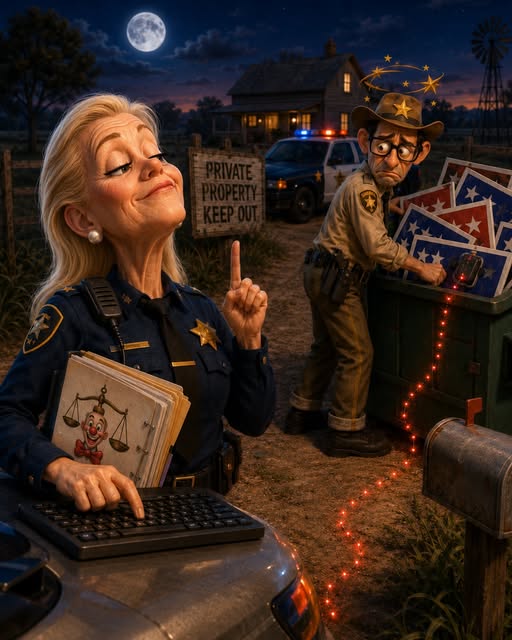


Keep it up. You’re doing yeoman’s work… Or yeoperson’s…