Gather around, children. Granny has found a tale from the enchanted kingdom of the City of Shelbyville, Indiana, where the servers are enormous, the public meetings are crowded, and the mayor has apparently appointed himself Royal Inspector of Other People’s Lawns.
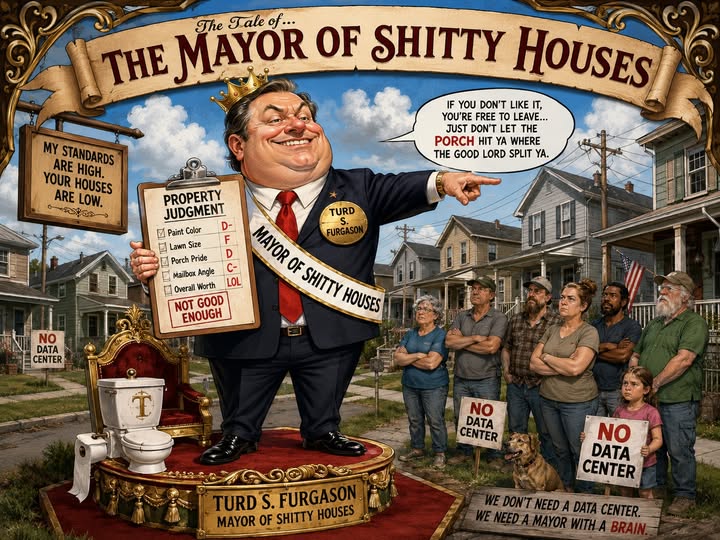
Once upon a time, a multibillion-dollar data-center proposal wandered into town wearing a shiny economic-development cape. It promised progress, prosperity, and enough blinking lights to make the countryside resemble a router having a nervous breakdown. Some residents were skeptical. They had questions about the scale of the project. They had concerns about their community. They placed “No Data Center” signs in their yards, which is the sort of ordinary civic participation elected officials generally claim to support when they are posing for campaign photographs beside an American flag.
Then the mayor encountered some of those signs.
Did he answer the residents’ concerns? Did he explain the proposal? Did he offer facts, figures, reassurance, or even the standard municipal casserole of buzzwords about transparency and community engagement?
No.
The mayor reportedly looked upon the homes of his own constituents and declared that he had only seen the signs in “shitty houses.”
That is not a paraphrase polished by an angry Facebook page. That is the vocabulary selection reportedly made by the actual mayor of an actual Indiana city while discussing the homes of the people he was elected to represent.
When someone correctly pointed out that these were working-class homes, the mayor added that most were rentals. Because apparently the Constitution contains a tiny footnote stating that freedom of speech expires the moment somebody does not own the shingles above their head.
Another person reminded him of a concept so elementary that most children master it before they are trusted with safety scissors: “It doesn’t matter whether they’re rentals. They’re still human beings.”
Imagine needing that sentence explained to you while serving as mayor. Imagine reaching a level of public office where a resident must gently lead you by the hand through the daring philosophical frontier of renters being people.
The mayor then attempted to refine his majestic thesis by describing the properties as unkempt. And there it was. The grand argument.
Not water. Not power consumption. Not noise. Not tax incentives. Not land use. Not long-term infrastructure. Not whether residents had legitimate questions about a massive development arriving in their community.
The yard looked shabby.
Therefore, apparently, the opinion growing inside the house could be discarded with the grass clippings.
The mayor’s office later issued the familiar ceremonial apology fog, explaining that his words were intended to address property maintenance rather than the character, value, or importance of residents. Naturally. He did not mean that renters mattered less. He merely introduced their rental status into the conversation immediately after dismissing their homes as shitty.
A perfectly ordinary coincidence.
Nothing to see here except a verbal rake lying directly in the path of the man who stepped on it.
This is the danger of small-pond royalty. Eventually, somebody begins mistaking a municipal title for a divine appointment. The office becomes a throne. Residents become scenery. Criticism becomes insolence. A yard sign becomes an offense against the crown.
The mayor of Shelbyville had an opportunity to make the case for a major project. Instead, he delivered a tiny master class in how to unify irritated people faster than any opposition campaign ever could.
Homeowners heard it. Renters heard it. Working families heard it. People with tidy lawns heard it. People with patchy lawns heard it. People who had not formed an opinion about the data center probably heard it and began wondering why their mayor was conducting a windshield census of which residents were worthy of having one.
The truly remarkable part is that the man was discussing a project built around advanced technology while deploying the political instincts of a medieval turnip baron.
Perhaps Shelbyville should update its tourism slogan:
Come for the small-town charm. Stay because the mayor is grading your porch.
And let this be a warning to every elected official who begins believing that a resident’s bank balance, property value, rental agreement, lawn height, or peeling porch paint determines whether their voice matters.
Those “shitty houses” contain voters. Those rental homes contain voters. Those working-class neighborhoods contain voters. And sometimes the people you dismiss from the comfort of your office become the people who show up together at the ballot box carrying receipts, yard signs, and one very memorable quotation.
The servers may be enormous.
But the mayor somehow made himself the smallest object in the room